
How AI Is Reshaping the Job Search & How to Prepare for What’s Next
Artificial intelligence is now embedded in almost every stage of hiring, with 69% of talent acquisition teams using AI tools for screening, assessments, and scheduling, and 63% of job seekers experiencing AI-run interviews. To stand out in 2026 and beyond, candidates must combine structured, data-backed interview practice with tools like the AI Interview Coach at LandThatRole.app, authentic human storytelling, and strategic 1-on-1 career coaching.
The way companies find, evaluate, and hire talent has undergone its biggest transformation since the invention of the online job board. Just a few years ago, artificial intelligence in recruiting meant basic keyword filters inside an Applicant Tracking System (ATS). Today, AI conducts preliminary video screenings, scores coding and behavioral assessments, matches candidates to open roles, and summarizes interviews for hiring managers.
At the same time, job seekers are adopting AI at record rates—78% of candidates report using or considering AI tools during their job search. Yet a massive paradox has emerged: more automation has made authentic human connection harder to spot, and therefore more valuable than ever.
Whether you are actively interviewing, preparing for a career pivot, or aiming for an executive promotion, understanding where AI is taking the hiring process—and how to train for it—will determine how fast you land your next offer.
The Current State and Future of AI in Hiring
If it feels like getting an interview has gotten harder while the process itself feels more automated, the data backs you up. Across industries, hiring is shifting toward an AI-assisted, skills-first model:
Automated Screening and Assessments Are Mainstream: Nearly 70% of talent acquisition teams use AI somewhere in their hiring funnel—led by resume screening (58%), candidate communication (54%), and skills assessments (50%).
AI-Led First-Round Interviews Are Growing Fast: Over 63% of job seekers report having participated in an AI-conducted or AI-evaluated interview within the past six months. Meanwhile, video interview summarization tools now cut recruiter review time by roughly 60% per candidate.
The "Look-Alike" Resume Problem: Because millions of applicants use generative AI to write cover letters and resumes, 64% of recruiters say they are seeing a flood of nearly identical applications. As a result, hiring managers rely far less on polished paper credentials and far more on live, real-time performance during interviews.
Agentic AI and Skills Graphs Are the Next Frontier: Looking toward 2027 and beyond, Gartner projects that 1 in 4 candidates will use autonomous AI agents to discover, evaluate, and apply to roles on their behalf. On the employer side, companies are moving away from rigid job titles toward AI-powered skills graphs that match candidates based on verified capabilities and adaptability.
Hiring Stage | Traditional Process | AI-Driven Reality (2026 & Beyond) | What It Means for Candidates |
Discovery & Sourcing | Manual job board searches and cold applications | AI matching algorithms and candidate-side research agents | Your digital footprint and clear skill taxonomy matter before you ever apply. |
Resume Screening | Basic keyword matching in an ATS | Semantic AI parsing and look-alike detection | Generic, AI-written resumes get filtered out; quantified impact wins. |
First-Round Screening | 15-minute recruiter phone screen | Asynchronous video interviews, AI transcription, and rubric scoring | Clarity, pacing, structured answers, and camera presence are critical. |
Final Interviews & Offer | Unstructured panel conversations | AI-assisted interview guides paired with deep human vetting | Authentic stories, emotional intelligence, and negotiation close the deal. |
Why Traditional Interview Prep No Longer Works
Most candidates still prepare for interviews the way people did ten years ago: reading a list of common questions, jotting down a few bullet points in a notebook, and hoping their natural charm carries them through the call.
That approach breaks down in modern hiring for three reasons:
You Can’t Wing Structured Rubric Scoring: Whether a human hiring manager or an AI evaluation tool is grading your response, modern interviews are scored against strict behavioral and technical rubrics. Rambling for four minutes without stating a clear outcome tanks your score.
Reading Notes Sounds Robotic: With 38.5% of video interviews triggering flags for suspected real-time AI assistance or script-reading, interviewers are hyper-sensitive to candidates whose eyes dart across the screen or whose answers sound overly rehearsed.
Feedback Loops Are Broken: When you get rejected after an interview, companies rarely tell you why. Without objective feedback on your pacing, filler words, or missing metrics, you risk repeating the exact same mistakes in your next five interviews.
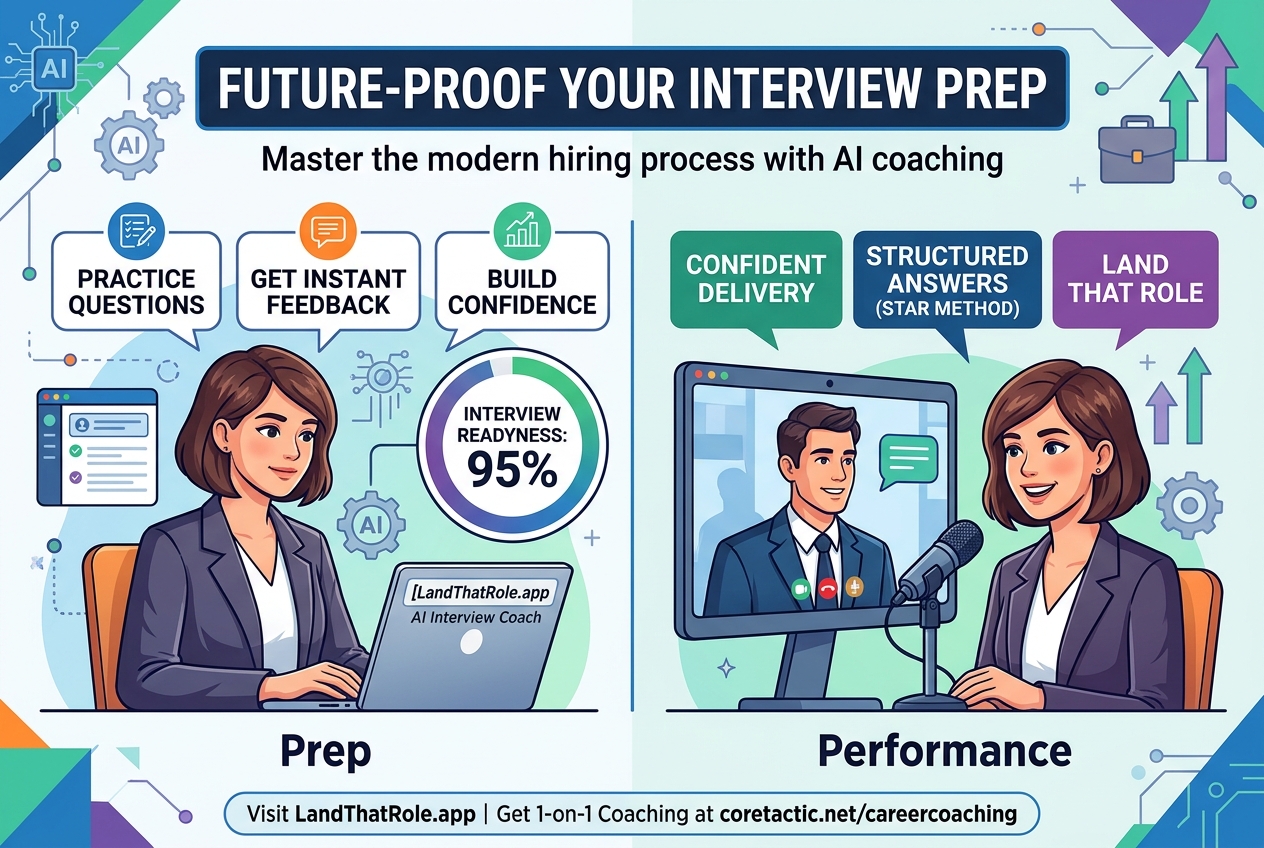
That's why we built the AI Interview Coach at LandThatRole.app—to give job seekers a realistic, low-stakes environment to practice out loud, get immediate, objective feedback, and sharpen their delivery before the real stakes are on the line.
How LandThatRole.app Bridges the Preparation Gap
Practicing in front of a mirror doesn’t tell you if your STAR story lacked a measurable result. Practicing with a friend rarely gives you role-specific follow-up pressure.
At LandThatRole.app, our AI Interview Coach simulates real-world interview dynamics tailored to your target role, industry, and experience level. Instead of passive study, you get active, repeatable reps:
Role-Specific Mock Interviews: Practice behavioral, situational, and technical questions customized to the exact job description you are targeting.
Instant, Actionable Feedback: Receive immediate analysis on answer structure, clarity, relevance, and whether you actually answered the core prompt.
Iterative Improvement: Refine weak answers on the spot and re-run tough questions until your delivery sounds confident, natural, and concise—never scripted.
7 Practical Tips to Ace AI-Assisted and Human Interviews
To thrive in an AI-enhanced hiring market, treat AI as a training partner, not a crutch. Use these seven strategies to outperform the competition:
1. Master the "STAR + M" Framework
Hiring rubrics—both human and algorithmic—reward clear cause-and-effect storytelling. Upgrade the classic STAR method (Situation, Task, Action, Result) by adding M for Metrics:
Situation & Task (20% of your answer): Set the context in two crisp sentences.
Action (50% of your answer): Focus on what you specifically decided, built, or led—use "I," not "we."
Result + Metrics (30% of your answer): Quantify the outcome (revenue generated, hours saved, error rate reduced, or customer retention improved).
2. Practice Speaking Your Answers Out Loud
Writing an answer down engages a completely different part of your brain than speaking it under time pressure. Run through full mock sessions on LandThatRole.app so you build muscle memory for transitions, pacing, and concise wrap-ups (aim for 90 to 120 seconds per behavioral answer).
3. Eliminate "AI-Sounding" Buzzwords
Because recruiters read hundreds of ChatGPT-generated applications every week, phrases like "delve into," "spearheaded cross-functional synergies," or "testament to my dedication" trigger instant skepticism. Speak in plain, concrete language about real trade-offs you faced and mistakes you learned from.
4. Optimize Your Audio and Speech Clarity
In automated video screenings, speech-to-text transcription accuracy directly affects how your response is evaluated. Use a clear external microphone or wired headset, sit in a quiet room with soft acoustics, and speak at a steady, measured pace so every technical term and metric is captured cleanly.
5. Research the Company Smarter—And Verify Everything
While 88% of job seekers use AI to research prospective employers, 68% say they still have to fact-check AI-generated company summaries. Before your interview, cross-check recent earnings reports, product launches, and leadership interviews directly on the company’s site so you bring accurate, up-to-the-minute insights to your questions.
6. Prepare for Adaptive Follow-Up Questions
Modern interviewers—and conversational AI screeners—don't just ask a static list of five questions. They probe deeper based on what you just said ("Why did you choose that approach over X?" or "What would you do differently today?"). Practice defending your reasoning with LandThatRole.app so follow-up questions feel like a natural conversation rather than an interrogation.
7. Pair AI Practice with Human Strategy
AI tools are unmatched for high-volume practice, instant scoring, and sharpening your delivery. However, navigating complex career pivots, executive positioning, resume repositioning, and high-stakes salary negotiations requires nuanced human judgment. Pairing your daily mock interviews on LandThatRole.app with personalized 1-on-1 career coaching at CoreTactic gives you both the tactical reps and the overarching career strategy needed to land top-tier offers.
Frequently Asked Questions About AI and Job Interviews
Will AI completely replace human interviewers?
No. While AI increasingly handles initial resume screening, scheduling, and first-round structured assessments, final hiring decisions remain overwhelmingly human. Companies use AI to filter volume so hiring managers can spend more time evaluating culture fit, leadership potential, and problem-solving in live conversations.
Do companies penalize candidates for using AI to prepare?
Employers penalize candidates for using AI to cheat or fabricate experience during live interviews, not for using AI to prepare beforehand. Using an AI interview coach to practice your storytelling, structure your examples, and reduce interview anxiety is viewed just like working with a tutor or practicing with a mentor.
How many mock interviews should I do before a real interview?
Aim for 3 to 5 focused practice sessions targeting the specific competencies listed in the job description. Space them out over several days so you can review feedback, tighten your stories, and internalize your key metrics without sounding memorized.
Ready to Turn Interviews Into Offers?
The future of hiring belongs to candidates who embrace technology without losing their humanity. Don't walk into your next interview cold—start practicing with realistic, role-tailored mock interviews today at LandThatRole.app.
And if you want hands-on guidance with your overall job search strategy, resume positioning, executive presence, or salary negotiation, explore personalized career coaching with CoreTactic to accelerate your next career move.